
Learn · Insights
Why an older antibiotic is part of our One-Day Intensive
Optimal TMS · TMS science · 10 min read
If you’ve read about our One-Day Intensive, you may have seen D-cycloserine mentioned as part of the protocol. Many patients seeking TMS treatment have tried several different medications, and it’s reasonable to be apprehensive about another prescription, especially one that few people have heard of. So what is it, and why do we use it at Optimal TMS?
The short answer
D-cycloserine is an older, well-studied medication, originally approved as an antibiotic. It acts on a receptor involved in learning and brain plasticity. It isn’t taken long-term, and it doesn’t change how you feel day to day. In our protocol, it’s given off-label as a single dose alongside TMS to help your brain respond more fully to the changes TMS is trying to produce.
This article explains what that means, where the evidence comes from, and why we include it in the One-Day protocol.
D-cycloserine (DCS) is a naturally occurring compound, first isolated in the 1950s as an antibiotic for tuberculosis. It works in that context by interfering with bacterial cell wall synthesis, a mechanism entirely unrelated to its effects in the brain.
In the 1990s, researchers began exploring DCS in a completely different context: as an enhancer of learning and memory. The mechanism of interest was its partial agonist activity at the NMDA receptor, a receptor type that plays a central role in synaptic plasticity and the cellular processes underlying learning. At the low doses used in neurological research, far below antibiotic doses, DCS doesn’t have meaningful antibiotic effects. What it does is change NMDA receptor activity in a way that lowers the threshold for neuroplastic change.
From there, DCS found its way into behavioral therapy research. Studies showed that DCS administered before exposure therapy for phobias, OCD, and PTSD enhanced the consolidation of the new learning that therapy was trying to produce. The brain, primed by DCS, was better at forming and stabilizing the new associations that therapeutic intervention was trying to build.
The same logic, priming the neuroplasticity machinery before a learning-promoting stimulus, eventually made its way to TMS research.
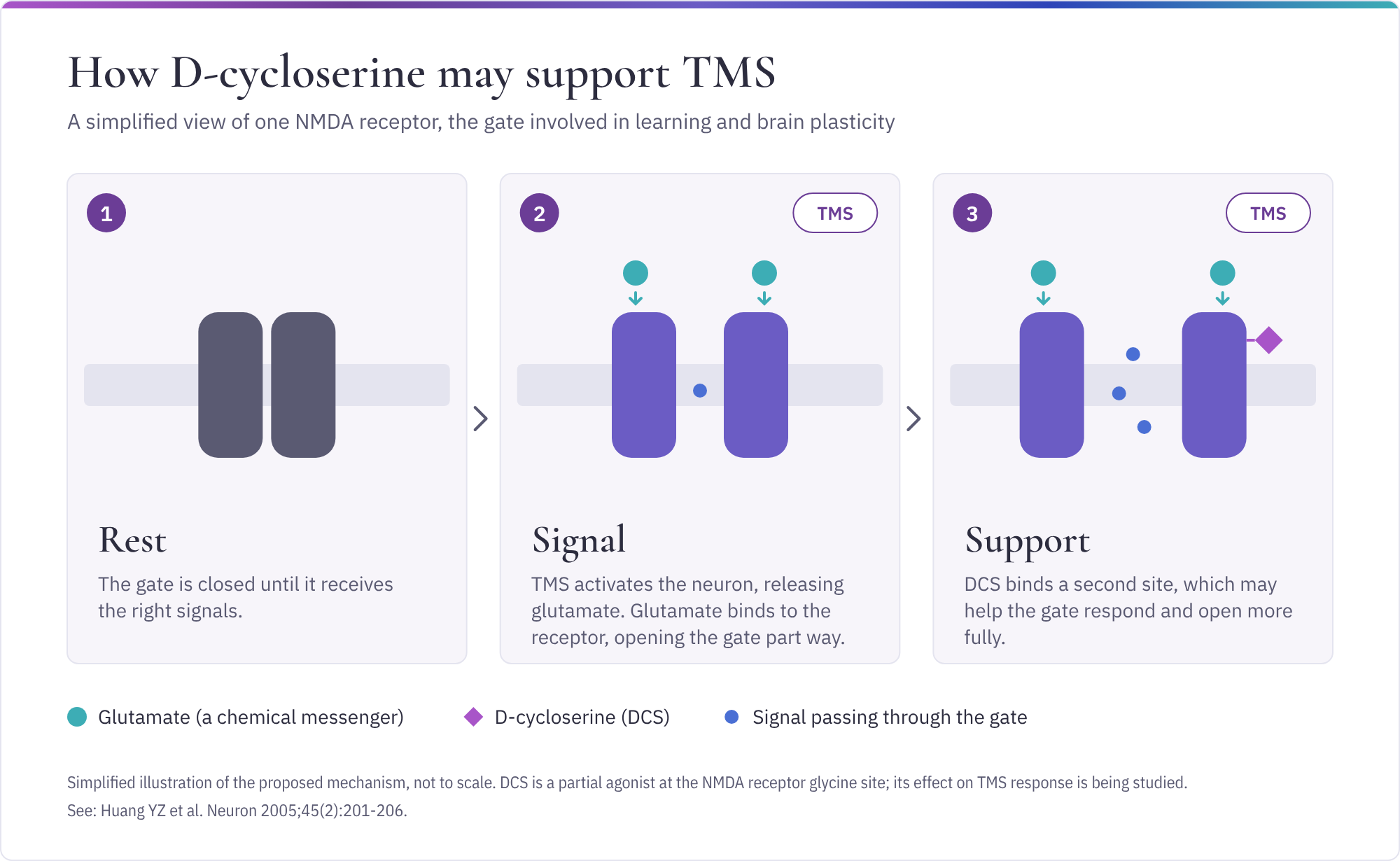
The NMDA receptor is one of the primary ways through which neurons strengthen their connections in response to activity. When two neurons fire together in a specific pattern, NMDA receptors at the synapse between them open, allowing calcium to flow in and triggering a cascade of molecular events that physically strengthen the connection. Strengthening physical connections between neurons is known as long-term potentiation, or LTP.
This is the cellular basis of learning, memory, and neuroplasticity. And it is the mechanism through which TMS produces lasting changes rather than transient ones. The magnetic pulses induce neuronal firing. That firing, in the right pattern and frequency, activates NMDA receptors and triggers LTP. LTP strengthens synaptic connections. Strengthened connections persist after treatment ends. The brain has rewired.
D-cycloserine acts as a partial activator at the NMDA receptor’s glycine binding site, one of the sites that must be occupied for the receptor to open fully in response to glutamate, our brain’s primary excitatory neurotransmitter. By occupying that site, DCS makes NMDA receptors more responsive to the glutamate that TMS-driven neural activity releases. The plasticity machinery is primed. The threshold for LTP induction is lower. The same TMS stimulus produces a stronger and more reliable neuroplastic response.
In other words
DCS makes the brain more ready to change in response to TMS. It doesn’t create the change; TMS does that. DCS makes the process more efficient and more complete.
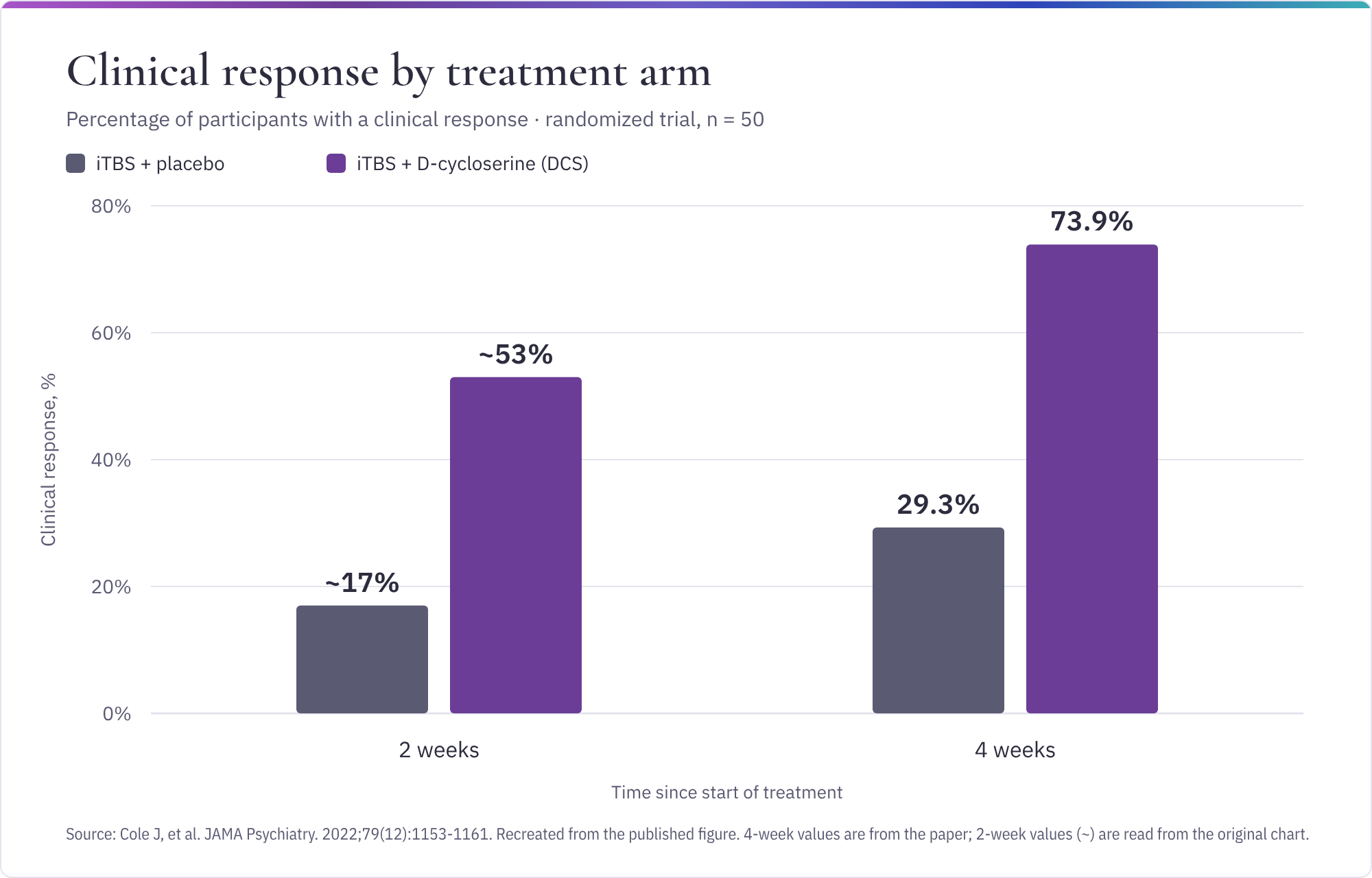
The primary published evidence for DCS augmentation of TMS comes from a randomized, double-blind, placebo-controlled trial published in JAMA Psychiatry in 2022 by Cole, Sohn, McGirr, and colleagues at the University of Calgary.
Fifty patients with major depressive disorder received a standard course of iTBS with either oral D-cycloserine or placebo before each session. Neither patients nor clinicians knew which they were receiving.
The results showed significantly greater reduction in depression scores in the DCS group compared with placebo over the course of treatment, with meaningfully higher remission rates and a steeper early response trajectory. The effect was most pronounced in patients with higher baseline depression severity, suggesting DCS augmentation may be particularly valuable precisely for the patients who need the most help. Adverse events were similar between groups; D-cycloserine at these doses was well tolerated and did not produce meaningful side effects beyond those of TMS itself.
A separate randomized study by Selby, MacMaster, and colleagues, published in Brain Stimulation in 2019, showed that DCS administered before a single iTBS session altered cortical facilitation in a way consistent with enhanced LTP, providing mechanistic confirmation at the physiological level that DCS is doing what the theory predicts.
The ONE-D protocol takes this evidence and applies it across all twenty sessions of a single treatment day. Rather than augmenting one daily session, DCS is administered right before a full day of twenty sessions, keeping the NMDA receptor primed throughout the treatment day and maximizing the neuroplasticity window across the entire protocol.
Psychiatric medications (antidepressants, anxiolytics, mood stabilizers) work by altering neurotransmitter availability or receptor sensitivity in a sustained, systemic way. They are in your system continuously, affecting your neurochemistry day and night. Their effects are often felt subjectively: changes in mood, energy, sleep, and emotional tone. Stopping them abruptly can cause withdrawal effects. They require ongoing daily adherence to maintain their effect.
D-cycloserine, at the doses used in TMS, does none of these things. It is taken once orally before TMS treatment, not daily and not continuously. It has a short half-life, clearing the system within hours. It does not produce mood changes, perceptual changes, or cognitive effects at these doses. It is not addictive and does not produce dependence. Stopping it requires no taper.
Its sole function in this context is to make NMDA receptors more responsive to glutamate during the period of TMS-driven neural activity. Once TMS is done for the day and DCS has cleared the system, its job is complete.
Patients sometimes ask whether DCS interacts with their current medications. The honest answer is that it sometimes does, depending on what you’re taking. Medications that affect glutamate or NMDA receptor function warrant discussion. We go through your full medication list during your consultation and will flag anything that needs attention. This is a routine part of the pre-treatment clinical review, not a reason for concern in most cases.
D-cycloserine is FDA-approved as an antibiotic. Using it alongside TMS is off-label, meaning it is prescribed for a purpose the FDA hasn’t specifically approved. Off-label use is common in medicine, and your provider will go over it with you at your consultation.
No, and the evidence doesn’t claim it does. The Cole et al. trial showed a group-level effect: on average, DCS-augmented patients did significantly better than placebo patients. Within that average, there was individual variation. Some patients in the placebo group did very well. Some patients in the DCS group did not achieve the remission the group average might suggest.
On average, DCS augmentation meaningfully improves the probability of a strong response to TMS at the population level. It does not guarantee a specific outcome for any individual patient. No treatment does.
We know the science behind it makes sense, the clinical evidence is positive from a well-designed randomized trial, the safety profile is clean, and the ONE-D study’s published outcomes, which used DCS before all twenty sessions, are the highest response and remission rates published for any TMS protocol. Whether DCS is responsible for all of that, some of it, or only one of several contributing factors cannot be fully isolated from a single-arm trial. But overall, the evidence supports its use.
Nothing, for most patients.
DCS at these doses does not produce subjective effects that patients typically notice. You take an oral capsule before each session. You do not feel sedated, stimulated, altered, or different in any way that most patients can identify. The TMS sessions feel like TMS sessions. DCS works at a molecular level that isn’t perceptible from the inside.
Rarely, patients report mild nausea, particularly early in the day on an empty stomach. Taking DCS with a light meal typically resolves this. Headache is the most commonly reported adverse effect, though it is difficult to separate DCS-specific headache from TMS-related headache in a single-arm protocol. No serious adverse events related to DCS were reported in the ONE-D study across 640 total sessions.
D-cycloserine is a neuroplasticity primer: a molecule that makes the brain’s learning machinery more responsive to the changes TMS is trying to produce. It has a forty-year safety record, a coherent and well-understood mechanism, positive randomized controlled trial evidence for TMS augmentation, and a practical profile: no subjective effects, no dependence, and no ongoing requirement after treatment is complete.
We include it in the One-Day Intensive because the evidence supports it, the mechanism is sound, and our clinical philosophy has always been to offer the most effective version of each protocol rather than the simplest one to administer. If there is a well-evidenced way to make TMS work better, we use it.
If you have specific questions about DCS and your medication regimen, your health history, or whether the One-Day Intensive is the right protocol for your situation, that’s exactly what your free consultation is for.
Sources