Read Our Research Blogs
The THREE-D Trial – iTBS Non-Inferior to Standard rTMS for Depression (Blumberger et al. 2018)
The THREE-D Trial – iTBS Non-Inferior to Standard rTMS for Depression (Blumberger et al. 2018) What this study was Who was studied What the protocol involved What the results showed What it means and what it doesn’t Why this study matters for patients What this study was The THREE-D trial is the largest randomized controlled trial comparing intermittent theta burst stimulation to standard high-frequency rTMS for major depressive disorder. It was a non-inferiority trial, meaning its primary question was not whether iTBS was better than rTMS, but whether it was at least as good. It was conducted across multiple Canadian
D-Cycloserine Augmentation of Intermittent Theta Burst Stimulation for Major Depressive Disorder (Cole, Sohn et al., 2022)
D-Cycloserine Augmentation of Intermittent Theta Burst Stimulation for Major Depressive Disorder (Cole, Sohn et al., 2022) What this study was Who was studied What the protocol involved What the results showed What it means — and what it doesn’t Why this study matters for patients What this study was This was a randomized, double-blind, placebo-controlled clinical trial evaluating whether D-cycloserine a partial NMDA receptor agonist improves the antidepressant effects of intermittent theta burst stimulation when administered immediately before each TMS session. It was conducted at the University of Calgary and published in JAMA Psychiatry in 2022 by Cole, Sohn, McGirr
The ONE-D Study — One-Day Theta Burst Stimulation for Treatment-Resistant Depression (Vaughn et al., 2025)
The ONE-D Study — One-Day Theta Burst Stimulation for Treatment-Resistant Depression (Vaughn et al., 2025) What this study was Who was studied What the protocol involved What the results showed What it means — and what it doesn’t Why this study matters for patients What this study was The ONE-D study is the first published clinical trial evaluating a complete course of accelerated iTBS delivered in a single day, augmented with D-cycloserine to enhance neuroplasticity throughout treatment. It was conducted at the University of Toronto and affiliated sites under the direction of researchers including Dr. Jonathan Downar, one of the
Your brain can change. Here’s what that actually means.
Your brain can change via Neuroplasticity. Here’s what that actually means. For decades, we assumed the adult brain was essentially fixed. You were born with a certain number of neurons, they wired themselves up during childhood and adolescence, and after that the structure was largely set. Mental illness, under this framework, was a malfunction in a static system, something to be managed, not fundamentally changed. That framework was wrong. What decades of neuroscience research have now established is that the adult brain retains a remarkable capacity for structural and functional change throughout life. Neurons form new connections. Existing connections strengthen

The Stanford SAINT Protocol – SNT Trial
The Stanford SAINT Protocol SNT Trial (Cole et al., 2022) The Stanford SAINT Protocol SNT Trial (Cole et al., 2022) What this study was Who was studied What the protocol involved What the results showed What it means and what it doesn’t Why this study matters for patients What the Stanford SAINT Protocol was The Stanford Neuromodulation Therapy trial, commonly called the SAINT study or SNT trial, is the most rigorous published evaluation of accelerated iTBS for treatment-resistant depression. It was a double-blind, randomized, sham-controlled trial, meaning neither patients nor the clinical staff administering treatment knew who was receiving real
What the SAINT Protocol Actually Showed… and What It Didn’t
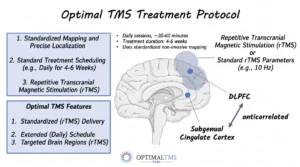
What the SAINT Protocol Actually Showed… and What It Didn’t In 2022, a paper published in JAMA Psychiatry reported something that hadn’t been seen before in the treatment of depression: a 78.6% remission rate in patients with treatment-resistant major depressive disorder, achieved in five days. For context, patients with treatment-resistant depression are the hardest population to treat. They’ve already tried medication. They’ve often tried therapy. They’ve been through the standard playbook and found it insufficient. Getting 78.6% of them into remission in five days, in a double-blind controlled trial, is not an incremental result. It’s a significant one. The study