What the SAINT Protocol Actually Showed... and What It Didn't
In 2022, a paper published in JAMA Psychiatry reported something that hadn’t been seen before in the treatment of depression: a 78.6% remission rate in patients with treatment-resistant major depressive disorder, achieved in five days.
For context, patients with treatment-resistant depression are the hardest population to treat. They’ve already tried medication. They’ve often tried therapy. They’ve been through the standard playbook and found it insufficient. Getting 78.6% of them into remission in five days, in a double-blind controlled trial, is not an incremental result. It’s a significant one.
The study was the Stanford Neuromodulation Therapy trial, which built on the earlier Stanford Accelerated Intelligent Neuromodulation Therapy work, the protocols collectively known as SAINT or SNT. It’s the scientific foundation for the Five-Day Intensive we offer at Optimal TMS.
But the details of what the study showed didn’t deserve more than a headline. This is our attempt to give you the complete picture.
Our Resources
What the SAINT Protocol Actually Showed… and What It Didn’t
The problem the study was trying to solve
Why the protocol is designed the way it is
What the study didn’t show and why it matters:
The problem the study was trying to solve
Traditional TMS has been FDA-cleared for depression since 2008. In the years since, thousands of patients have completed traditional rTMS courses and many have benefited. But two problems have consistently limited its impact.
The first is efficacy. Real-world remission rates for traditional once-daily rTMS are approximately 30–35%. That means roughly two-thirds of patients don’t achieve remission. Meaningful improvement short of full remission still occurs in roughly half to two-thirds of patients, which is better, but still leaves a large proportion without adequate relief.
The second is the schedule. Thirty-six sessions over six weeks is a significant commitment. For patients managing jobs, families, travel distances, or simple life complexity, six weeks of daily clinic visits is a real barrier to care and a reason many patients who might benefit from TMS never attempt it.
The researchers behind SAINT were trying to solve both problems at once: dramatically improve efficacy while compressing the treatment timeline. The protocol they developed did exactly that but the mechanism behind why it works is as important as the results themselves.
Why the protocol is designed the way it is
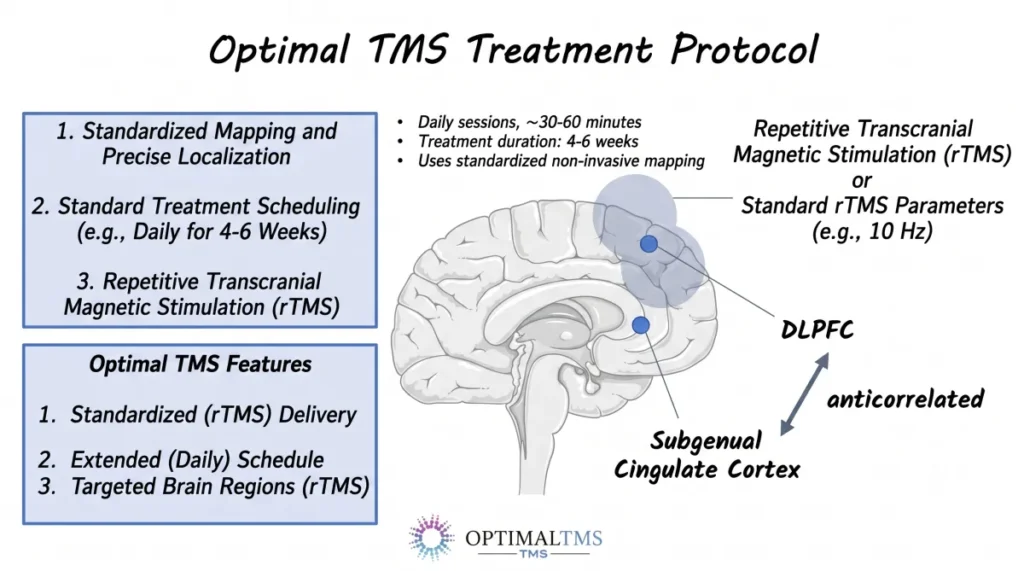
The SAINT protocol delivers ten iTBS sessions per day across five consecutive days. Each session takes approximately three minutes. Sessions are spaced fifty minutes apart.
That spacing is not logistical convenience, it’s biology.
Each iTBS session induces a neuroplasticity window: a period of heightened synaptic responsiveness during which the next session’s effects compound on the previous one. The fifty-minute inter-session interval is timed to catch the subsequent session while that window is still open, before the potentiation signal dissipates.
Traditional once-daily TMS delivers one session per day. The twenty-three hours between sessions allows that neuroplasticity window to close entirely before the next stimulus arrives. The result is thirty-six independent stimulation events rather than fifty compounding ones. The distinction is biological, not just mathematical and it explains why the efficacy profiles are so different despite both protocols using similar total pulse counts.
Ten sessions per day across five days isn’t just faster than traditional TMS. It’s a fundamentally different biological dose.
What the trial actually found
The 2022 JAMA Psychiatry paper enrolled 29 patients with treatment-resistant major depressive disorder meaning they had failed to respond adequately to at least one antidepressant. Patients were randomly assigned to active SNT treatment or sham treatment in a double-blind design. Neither patients nor the clinical staff knew who was receiving real stimulation.
The primary outcome was remission at day five, measured using the Montgomery-Åsberg Depression Rating Scale (MADRS), one of the standard validated tools for measuring depression severity. Remission was defined as a MADRS score below a specified threshold indicating minimal depressive symptoms.
The results:
78.6% of active treatment patients met remission criteria at day five, 13.3% of sham patients met remission criteria (confirming this was not a placebo effect).
Mean time to remission was 2.6 days, with many patients showing meaningful change before the protocol was complete. Remission rates remained significantly higher in the active group at the one-month follow-up
The separation between the active and sham groups (78.6% versus 13.3%) is one of the largest treatment effect sizes reported in any depression trial. In a population that had already failed prior treatment, it represents a meaningful signal that this protocol is doing something traditional approaches are not.
What the study didn’t show and why it matters:
Being honest about a study’s limitations is as important as being excited about its findings. There are several things the SAINT trial did not establish that are worth understanding.
It was a small trial. Twenty-nine patients is not a large sample. The results are statistically significant and the effect size is large, but small trials are more susceptible to noise. The findings need replication in larger populations before they can be considered fully established. Several larger trials are currently underway.
The original protocol used fMRI-guided targeting. The Stanford team individualized each patient’s stimulation site using functional MRI connectivity mapping. Specifically, they identified the area of the left DLPFC most functionally connected to the subgenual anterior cingulate cortex for each patient individually. This level of individualization is not standard at most TMS clinics, including ours.
Our Five-Day Intensive uses validated scalp-based targeting, which is how the large majority of clinical TMS is delivered. Whether fMRI-guided targeting produces meaningfully better outcomes than standard targeting in an accelerated protocol is an open question, the answer isn’t settled in the literature.
It was conducted in a research setting with highly controlled conditions. Real-world clinical outcomes may differ from trial outcomes. Patients in trials are often more carefully selected, more closely monitored, and treated under conditions that differ from standard clinical practice.
Remission at day five is not the same as durable remission. The one-month follow-up data was encouraging, but longer-term durability data from large populations is still developing. Published evidence from prior accelerated TMS work suggests effects are durable but durability in real-world patients over years is not yet as well-characterized as short-term outcomes.
None of these limitations negate the finding. They contextualize it. A 78.6% remission rate in a double-blind controlled trial in treatment-resistant patients is a remarkable result regardless of sample size. But a patient making a treatment decision deserves to know the full picture, not just the headline.
What we do and don’t replicate at OptimalTMS
Our Five-Day Intensive is modeled after the SAINT/SNT protocol in the aspects that are most clinically meaningful and practically deliverable:
What we replicate: Ten iTBS sessions per day for 5 consecutive days… 50 sessions total. We use the same stimulation parameters (about 1,800 pulses per session), 50Hz triplet bursts at 5Hz carrier frequency. We deploy the same fifty-minute inter-session interval timing for delivery to an awake patient in a clinical setting
What we don’t replicate: fMRI-guided individualized targeting. We use standard validated scalp-based targeting which is the same approach used at the large majority of TMS clinics worldwide.
We are not affiliated with Stanford University, the Stanford Department of Psychiatry, or the SAINT study authors. When we reference their research, we are citing peer-reviewed published science. We are not claiming their endorsement, their institutional protocols, or equivalence to their specific research conditions.
Why choose this protocol?
The decision to model our Five-Day Intensive after the SAINT protocol wasn’t a marketing choice. It was a clinical one.
The SAINT trial produced the strongest published efficacy data for accelerated TMS in treatment-resistant depression. When our lead provider evaluated the available evidence for accelerated protocols, the SAINT data stood out not just for its remission rates but for the rigor of the trial design. It’s randomized, double-blind, sham-controlled. Those are the conditions under which you can actually trust a result.
We also believe the mechanistic rationale… the neuroplasticity window argument for why multiple daily sessions compound rather than simply accumulate… is sound and supported by both the clinical outcomes and the growing basic science literature. A preclinical study published in Cell in 2026 identified the specific prefrontal neurons activated by accelerated iTBS and showed that their activation was causally required for the antidepressant behavioral effects. The biology is coherent with the clinical results.
For patients who want the most evidence-backed accelerated option currently available, the Five-Day Intensive represents our best answer to that question. We won’t promise you Stanford’s trial results, as no clinic can promise any individual patient a population-level statistic. But we’ll deliver the protocol those results came from, administered by doctoral-level providers who understand why it works.
Sources
AMA Psychiatry. 2022;179(2):132–141.